Prefinished Hardwood Flooring: Installation and Buyer Guide
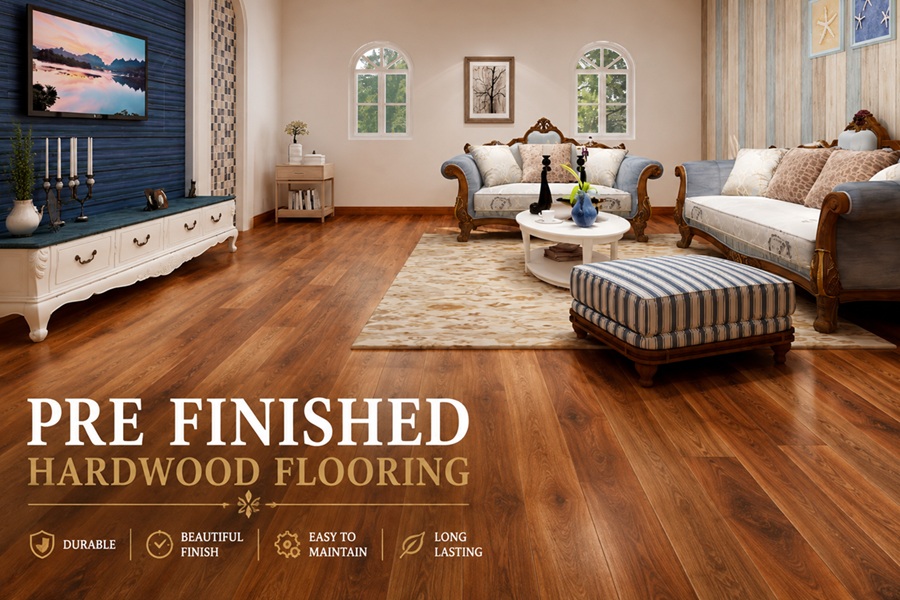
Prefinished hardwood flooring is real wood flooring that comes from the factory already sanded, stained, and sealed, so it installs quickly and is ready to walk on the moment the last board is down, with no on-site sanding, staining, or finishing. That factory-applied finish, often a tough aluminum oxide coating, is a major reason people choose it: it is more durable and consistent than a finish applied in your home and skips the dust, fumes, and days of drying that unfinished floors require. The main trade-offs are small bevels between the boards and a fixed range of finish colors, which most homeowners happily accept for the speed and convenience.
Where prefinished flooring really stands apart is installation, since removing the messy finishing step makes it faster and, for some products, approachable as a DIY project. This guide focuses on the practical side, how prefinished flooring is installed, how the finish and edges behave, the difference between solid and engineered, and how to choose boards that will look great and last, so you know exactly what you are getting.
| What it is | Wood flooring finished at the factory before installation |
| Ready to use | Immediately after installation |
| Finish | Durable factory coating, often aluminum oxide |
| Install methods | Nail, staple, glue, or floating click-lock |
| Edges | Usually small bevels between boards |
| Types | Solid and engineered |
| DIY potential | Good, especially for floating floors |
| Main appeal | Fast, clean install with a tough finish |
How the Factory Finish Helps
The defining feature of prefinished flooring is that all the finishing happens in a factory before the boards reach your home. Each plank is sanded smooth, stained to the chosen color, and sealed with multiple layers of a durable coating, then cured and packaged. This controlled process produces a harder, more even finish than anyone can achieve on site, and coatings like aluminum oxide are prized for their strong scratch and wear resistance.
For you, the practical payoff is huge. There is no sanding dust filling your home, no staining or polyurethane fumes, and no waiting days to walk on the floor while a site-applied finish cures. The floor is finished the instant installation is complete, which makes the whole project faster, cleaner, and far less disruptive than an unfinished floor sanded in place.
How Prefinished Flooring Is Installed
Because the finishing step is gone, installing prefinished flooring is more approachable, and the method depends on the product and your subfloor. There are a few common approaches, each suited to different situations.
| Method | How It Works | Best For |
| Nail or staple down | Fastened to a wood subfloor | Solid wood over plywood |
| Glue down | Adhered to the subfloor | Engineered over concrete |
| Floating click-lock | Boards lock together, not fastened | Easy DIY over many subfloors |
| Over radiant heat | Usually engineered, glued or floated | Homes with radiant heating |
Preparing for a Successful Install
Whatever the method, a few preparation steps make or break the result, and they matter just as much for prefinished flooring as for any wood floor. Skipping them causes gaps, squeaks, or buckling later, so they are worth doing carefully.
- Acclimate the flooring in the room for the recommended time so it adjusts to the humidity
- Ensure the subfloor is clean, dry, level, and structurally sound
- Add a moisture barrier over concrete to protect the wood
- Use the correct underlayment for floating floors
- Leave an expansion gap around the edges so the floor can move
Understanding the Bevels
One characteristic to expect with prefinished flooring is small bevels, slight V-shaped grooves, where the finished edges of the boards meet. These exist because each board is finished individually, so a tiny beveled edge gives a clean, defined line between planks and hides minor height differences. The look is a defined, plank-by-plank appearance that many people like. The only practical downside is that the grooves can collect a little dust, though regular sweeping handles that easily. It is simply a different aesthetic from the perfectly flat, seamless surface of a sanded unfinished floor.
Solid vs Engineered Prefinished
Prefinished flooring comes in both solid and engineered constructions, and choosing between them depends mostly on where it is going. Solid prefinished planks are milled from one piece of wood and suit dry, above-grade rooms, with the ability to be refinished multiple times over their life. Engineered prefinished planks have a real-wood veneer over a stable layered core, which handles humidity, concrete subfloors, and radiant heat far better, making them the go-to for basements and challenging installations. Match the construction to the room rather than choosing on looks alone, since both can look identical on the surface.
Durability and Everyday Care
The hard factory finish gives prefinished floors strong resistance to scratches and daily wear, which is why they hold up so well in busy homes. Caring for them is simple: sweep or dust regularly to keep grit off the surface, clean with a hardwood-safe product rather than soaking the floor, use felt pads under furniture, and place mats at entrances. Over many years, solid prefinished floors can be sanded and refinished, while engineered ones can be refinished a limited number of times depending on the veneer thickness, giving real wood a longevity few other floors match.
How to Choose the Right Boards
Choosing well means balancing looks, durability, and your space. Harder species like oak, hickory, and maple resist dents better in high-traffic areas, while the finish sheen and board width shape the style, from formal narrow strips to relaxed wide planks. Consider the room’s moisture and subfloor to decide between solid and engineered, check the wear-layer thickness on engineered products if you want future refinishing, and weigh the warranty, since a long wear warranty signals a confident, durable finish. Matching these to your home ensures you love the floor for years.
Frequently Asked Questions
Is prefinished hardwood easy to install?
It is more approachable than unfinished flooring because it skips the difficult on-site finishing step. Floating click-lock products are especially DIY-friendly, while nail-down and glue-down installs are more involved. Proper acclimation and subfloor prep are essential in every case.
Why does prefinished flooring have grooves between boards?
Those small bevels come from finishing each board individually. They give a clean, defined plank look and hide minor height differences. They can collect a little dust, but regular sweeping keeps them clean.
Can prefinished floors be refinished later?
Yes. Solid prefinished floors can be sanded and refinished several times, and engineered ones a limited number of times depending on the veneer thickness. Refinishing removes wear and lets you change the color down the road.
Is prefinished or unfinished flooring better?
It depends on your priorities. Prefinished installs faster and cleaner with a very durable factory finish, while unfinished allows a fully custom stain and a seamless, bevel-free surface. Most homeowners choose prefinished for the convenience and durability.
Prefinished vs Site-Finished at a Glance
It helps to see prefinished flooring against the alternative, site-finished flooring, which is installed raw and then sanded and finished in your home. Each has a clear case, and knowing the differences confirms whether prefinished is right for you.
Prefinished wins on speed, cleanliness, and finish durability: it installs fast, creates no sanding dust or fumes, and carries a tough factory coating. Site-finished flooring wins on customization and a seamless surface, since you can choose any stain color and the sanded floor has no bevels between boards. The trade-off is time and mess, as site finishing takes longer and fills the home with dust and fumes while the finish cures.
For most homeowners, the convenience, durability, and predictability of prefinished flooring make it the default choice, especially when they want to use the room quickly. Site finishing appeals mainly to those set on a custom color or a perfectly flat, bevel-free floor and willing to accept the extra time and disruption. Knowing which of those priorities matters most to you points to the right option.
- Prefinished: fast, clean, durable factory finish, small bevels
- Site-finished: custom color, seamless surface, more time and mess
- Prefinished lets you use the room immediately
- Site-finished suits custom colors or a bevel-free look
- Most homeowners pick prefinished for the convenience
Final Thoughts
Prefinished hardwood flooring gives you genuine wood with a faster, cleaner installation and a factory finish tougher than most site-applied coatings. The keys to success are choosing the right construction for your room, solid for dry above-grade spaces and engineered for basements, concrete, or radiant heat, and preparing the subfloor and acclimating the boards properly before you install. Accept the small bevels and fixed color range as fair trade-offs, care for the floor simply, and you get a beautiful, hard-wearing hardwood floor you can walk on the very same day.