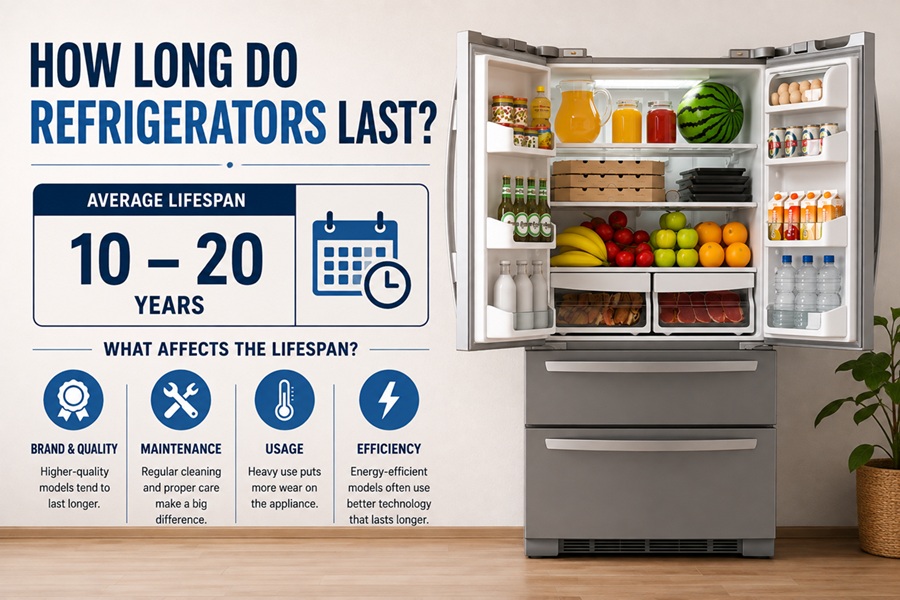
On average, a refrigerator lasts between 10 and 20 years, with most units giving reliable service for about 13 to 15 years before repairs start costing more than a replacement would. The exact number depends heavily on the type of fridge, how often it runs, the climate it sits in, and whether it gets even basic maintenance along the way.
That said, a refrigerator’s lifespan isn’t just a number printed on a warranty card. A poorly maintained top-freezer model can quit at year eight, while a well-cared-for French door fridge can push past 17 years without a single major repair. Below, we’ll walk through what actually drives that number, how different types compare, what shortens a fridge’s working life, and how to tell when yours is genuinely on its way out rather than just having an off week.
Quick Facts
| Average Lifespan | 10 – 20 years |
| Best Performing Type | Top-freezer models |
| Shortest Lifespan Type | Built-in / side-by-side with icemakers |
| Typical Compressor Life | 15+ years if well maintained |
| Common Failure Point | Compressor, door seals, evaporator fan |
| Recommended Coil Cleaning | Every 6 months |
| Average Repair Cost | $200 – $400 |
| Signs of Replacement Need | Frequent repairs, warm spots, rising energy bills |
Why Refrigerator Lifespan Varies So Much
It helps to understand that a refrigerator isn’t one appliance, it’s several systems working together nonstop: a compressor that pumps refrigerant, a set of coils that release heat, a fan that circulates cold air, and door seals that keep that cold air locked inside. Every one of those parts wears down at its own pace, and the fridge’s overall lifespan is really just a reflection of whichever part fails first.
That’s why two identical fridges, bought the same week from the same store, can age completely differently depending on their households. A fridge in a hot garage running nonstop through summer will age faster than the same model in a climate-controlled kitchen. A household that opens the door forty times a day puts more strain on the compressor than one that opens it a dozen times.
Manufacturers design most modern refrigerators with an expected service life somewhere in the 10 to 15 year range, but that number assumes average conditions and at least minimal upkeep. Skip the upkeep entirely, and you can knock several years off that estimate without realizing it.
Lifespan by Refrigerator Type
Not every refrigerator wears out at the same rate. Simpler designs with fewer moving parts and fewer built-in features tend to outlast the feature-heavy models that pack in ice makers, water dispensers, and dual compressors.
Here’s a general comparison based on typical usage patterns and the repair histories most appliance technicians report seeing in the field.
| Refrigerator Type | Average Lifespan | Notes |
| Top-Freezer | 15 – 20 years | Fewest moving parts, most reliable overall |
| Bottom-Freezer | 13 – 17 years | Slightly more complex mechanics than top-freezer |
| Side-by-Side | 12 – 15 years | More components, higher failure rate |
| French Door | 12 – 17 years | Varies heavily by brand and build quality |
| Built-In / Panel-Ready | 18 – 20 years | Expensive but engineered for longevity |
| Mini Fridge / Compact | 6 – 10 years | Cheaper components, shorter working life |
Why Simpler Models Often Outlast Feature-Rich Ones
An ice maker sounds like a small convenience, but it adds a water line, a solenoid valve, and a small motor, each of which is one more thing that can eventually fail or leak. The same goes for through-door water dispensers and dual-zone cooling systems.
None of this means feature-rich fridges are a bad choice. It simply means the more complex the machine, the more individual points of failure it has, and the more likely something small breaks before the compressor itself ever does.
What Shortens a Refrigerator’s Life
A refrigerator runs nonstop, every single day of the year, which means small issues compound quickly instead of staying minor. A handful of everyday habits and conditions are responsible for most premature failures.
- Dust-clogged condenser coils, forcing the compressor to run longer and hotter than it should
- Frequent door opening or leaving the door ajar, which lets warm air in constantly
- Overpacking shelves, which blocks internal airflow and forces the compressor to compensate
- Setting the temperature colder than necessary, adding unnecessary strain for no real benefit
- Placing the fridge next to a stove, dishwasher, or in direct sunlight, all of which add ambient heat
- Ignoring a failing door seal, which lets cold air leak out around the clock
Signs Your Refrigerator Is on Its Way Out
Refrigerators rarely die without warning. Most give a few clear signals in the weeks or months leading up to a full breakdown, and catching them early can mean the difference between a simple repair and an emergency replacement.
Watch for these patterns rather than waiting for the compressor to stop entirely.
| Warning Sign | What It Usually Means |
| Motor running constantly | Compressor struggling, or seals may be worn |
| Food spoiling faster than usual | Inconsistent internal temperature |
| Excess condensation or frost buildup | Door seal failure or blocked airflow |
| Loud buzzing, rattling, or clicking | Compressor or fan motor wearing out |
| Rising electricity bill with no other changes | Unit working harder to hold temperature |
| Cracks, rust, or pooling water near the base | Structural wear, often paired with a slow leak |
Repair or Replace? A Simple Way to Decide
A common rule of thumb in the appliance repair world is the 50 percent rule. If a repair quote comes in at more than half the price of a comparable new unit, replacement usually makes more financial sense than fixing it.
Age matters just as much as the repair cost itself. A pricey repair on a 4-year-old fridge is often worth doing, since most of the machine still has plenty of life left. That same repair on a 14-year-old unit rarely pays off, because other parts are likely close to failing too, and you could be back to square one within a year.
| Fridge Age | Repair Cost vs New Price | General Recommendation |
| 0 – 5 years | Any reasonable cost | Repair |
| 6 – 9 years | Under 40% of new price | Repair |
| 10 – 13 years | Under 25% of new price | Repair with caution |
| 14+ years | Any cost | Replace |
How to Help Your Refrigerator Last Longer
A few simple habits can add real years to your refrigerator’s working life, and none of them require any technical skill.
- Clean the condenser coils twice a year using a vacuum or coil brush
- Leave at least two inches of clearance around the back and sides for airflow
- Test door seals periodically by closing the door on a piece of paper and pulling it out
- Keep the fridge set to 37°F and the freezer to 0°F, no colder
- Avoid overpacking shelves so cold air can circulate freely
- Vacuum dust from underneath and behind the unit, not just the visible coils
The Hidden Cost of Keeping an Aging Fridge Too Long
It’s tempting to keep squeezing life out of an old refrigerator, especially if it’s still technically running. But an aging compressor working overtime doesn’t just risk sudden failure, it quietly drives up your electricity bill month after month, often by 20 to 30 percent compared to a newer, more efficient model.
There’s also a real risk with food safety. A fridge that’s struggling to hold temperature consistently can leave perishables in the danger zone without any obvious sign, which is a bigger downside than most people factor into the repair-or-replace decision.
It’s worth running the numbers honestly. An old fridge quietly costing an extra $8 to $15 a month in electricity adds up to $100 to $180 a year, money that could instead go toward a newer, more efficient replacement that also comes with a fresh warranty.
How Placement and Installation Affect Longevity
Where a refrigerator sits in your home has more impact on its lifespan than most people expect. Compressors are designed to release heat efficiently, and anything that traps that heat around the unit forces it to work harder around the clock.
Garages and unfinished basements are common problem spots, especially in climates with hot summers or freezing winters, since most standard refrigerators aren’t designed to operate reliably outside a fairly narrow ambient temperature range.
| Installation Factor | Impact on Lifespan |
| Less than 1 inch clearance around unit | Restricts airflow, shortens compressor life |
| Placed next to oven or dishwasher | Added ambient heat increases strain |
| Installed in unconditioned garage | Extreme temperatures can damage components |
| Uneven flooring | Door seal misalignment, cooling leaks |
| Proper clearance and level installation | Supports full expected lifespan |
Is an Extended Warranty Worth It?
Most refrigerators come with a standard manufacturer warranty covering one year on parts and labor, sometimes extending five to ten years on the compressor specifically, since that’s historically the most expensive part to replace.
An extended warranty can make sense for higher-end built-in models where a single repair visit might otherwise cost several hundred dollars, but for basic top-freezer models, the math often doesn’t favor the extra cost, since the appliance itself is relatively inexpensive to replace outright.
What to Do With Your Old Refrigerator
Once a fridge is genuinely at the end of its life, don’t just leave it curbside. Refrigerators contain refrigerant and insulating foam that require proper handling, and many local utility companies or municipalities offer free pickup and recycling programs, sometimes with a small rebate attached.
If the unit still runs but you’re upgrading for other reasons, donating it or selling it secondhand is often a better option than recycling, giving it a second life in another household before it eventually reaches the end of its usable years.
Frequently Asked Questions
Do refrigerators really last 20 years?
Some do, particularly simple top-freezer models and high-end built-in units that get regular coil cleaning and aren’t overworked. It’s the upper end of the range rather than the average, though.
Does brand matter more than type?
Type and build quality both matter, but consistent maintenance tends to make a bigger difference than brand alone. A mid-range fridge that’s cleaned and cared for regularly can easily outlast a premium model that’s neglected.
Is it normal for a refrigerator to run all the time?
A refrigerator cycles on and off throughout the day, but constant, nonstop running usually signals dirty coils, a failing seal, or a compressor under strain, not normal operation.
Should I replace a refrigerator before it fully breaks?
If it’s over 13-15 years old and needs a repair costing more than a third of a new unit’s price, replacing it proactively usually saves money and hassle in the long run.
Can a refrigerator’s location really shorten its life?
Yes. Garages, uninsulated basements, and spots near ovens or heat sources all force the compressor to work harder than it would in a standard kitchen setting, which adds up over the years.
Is it better to repair the compressor or replace the whole fridge?
It depends on age. A compressor replacement on a unit under 7 years old is usually worthwhile, but on anything past 10 to 12 years, replacing the whole fridge is typically the more practical choice.
Final Thoughts
Most refrigerators will comfortably serve a household for well over a decade, and many stretch past 15 or even 20 years with basic care. Pay attention to the early warning signs, keep the coils clean twice a year, and don’t ignore a rising energy bill — it’s often the first quiet clue that your fridge is asking for help before it eventually asks for retirement.