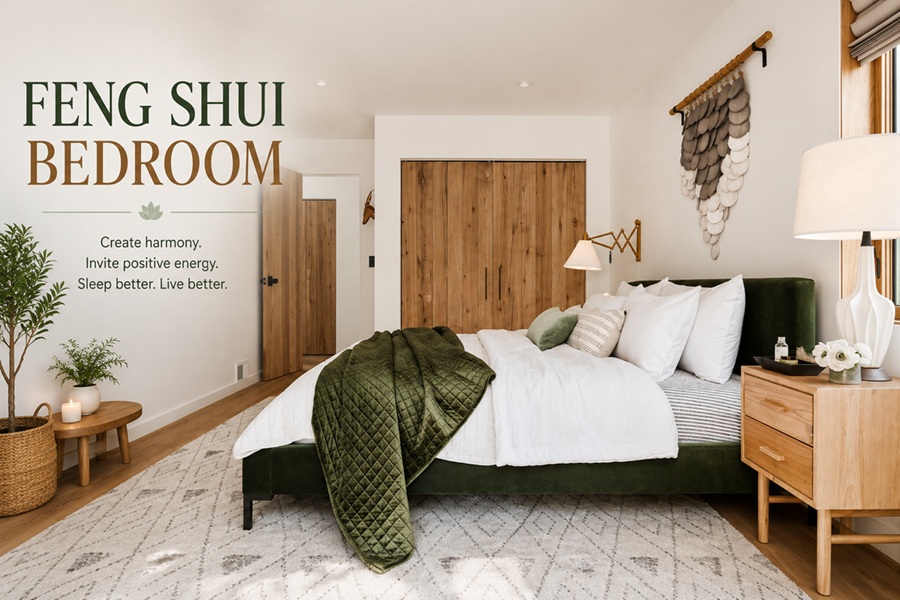
A feng shui bedroom is a room arranged so that energy, or “chi,” can move freely and settle calmly around the bed. In practice, this means positioning the bed in a commanding spot, choosing soothing colors, clearing clutter, and keeping electronics and mirrors away from where you sleep. The goal isn’t decoration for its own sake — it’s a layout that supports rest, health, and stronger relationships.

Sleep quality, mood, and even how couples relate to each other are all tied, at least symbolically, to how a bedroom is set up. A room that feels cramped, chaotic, or oddly arranged tends to leave people restless without them knowing exactly why. Feng shui gives you a practical checklist to fix that, room by room, without needing a full renovation.

Feng Shui Bedroom Basics at a Glance

Element Feng Shui Guideline
Bed position Diagonal from the door, in the “commanding position”
Headboard Solid and flush against a wall
Mirrors Never directly facing the bed
Under the bed Open, storage-free if possible
Colors Earth tones, soft neutrals, muted warm shades
Electronics Turned off or removed at night
Nightstands A matching pair, one on each side
Windows Bed not placed directly beneath one

Keep this table as a quick reference. The sections below go deeper into each rule and why it matters.

Where Feng Shui Comes From

Feng shui is a centuries-old Chinese practice built around the idea that the placement of objects affects the flow of energy through a space. “Feng” means wind and “shui” means water — together, they represent movement and flow. Bedrooms get special attention in this system because you spend roughly a third of your life there, often more if you work from home or nap during the day.

Whether or not you believe in energy flow literally, many feng shui principles overlap with common-sense design: reduce clutter, avoid sharp edges near where you sleep, and create a layout that feels stable rather than exposed. That’s part of why the practice has stuck around.

The Commanding Position: Where to Place Your Bed

This is the single most important rule in bedroom feng shui. The “commanding position” means your bed is placed so you can see the door from bed, without being directly in line with it, and ideally diagonally across the room from the entrance.

A few reasons this placement matters:

  • You’re not startled by anyone entering while your back is turned
  • The wall behind the headboard provides a sense of support and stability
  • You avoid the so-called “coffin position,” where your feet point straight at the door

If your room’s layout makes the exact commanding position impossible, a mirror placed so you can see the door’s reflection from bed is considered an acceptable workaround.

Bed Placement Do’s and Don’ts

Do Don’t
Place bed diagonal from the door Place bed directly in line with the door
Keep a solid wall behind the headboard Put the headboard under a window
Leave equal space on both sides of the bed Push one side of the bed against a wall
Use a solid, sturdy headboard Use a headboard with slats or no headboard at all

Equal space on both sides isn’t just about symmetry — it’s meant to represent balance, especially for couples. A bed shoved into a corner with one side unreachable is thought to symbolically crowd one partner out.

Feng Shui Bedroom Colors

Color choice plays a bigger role in feng shui than most people expect. Bright, high-energy colors like fire-engine red or neon orange are considered too stimulating for a room meant for rest. Instead, the practice favors muted, grounding tones.

Color Family Feng Shui Association Best Use
Soft blues and greens Calm, healing, water/wood energy Walls, bedding
Earthy beige and terracotta Stability, grounding Walls, rugs
Blush and dusty pink Romance, gentle warmth Accents, textiles
Warm neutrals (cream, taupe) Balance, versatility Large surfaces
Deep charcoal or black Protection, depth, water element Small accents only

Avoid painting an entire bedroom in stark white, which some feng shui practitioners consider cold and overly clinical, or in high-saturation red, which is thought to overstimulate the nervous system right where you’re trying to unwind.

The Five Elements and How to Use Them

Traditional feng shui organizes the world into five elements: Wood, Fire, Earth, Metal, and Water. A well-balanced bedroom usually leans on two or three of these rather than trying to force all five into one small space.

Element Represents Easy Way to Add It
Wood Growth, vitality Wooden furniture, plants
Fire Passion, energy Candles, warm lighting
Earth Stability, grounding Ceramics, earthy colors
Metal Clarity, precision Metal frames, mirrors (placed correctly)
Water Calm, flow Dark tones, glass, mirrors

You don’t need to overhaul your whole room to hit this balance. Swapping a plastic lamp for a wooden one, or adding a single ceramic vase, can be enough to round things out.

What to Avoid in a Feng Shui Bedroom

Some choices are considered disruptive no matter how the rest of the room is arranged.

  • Mirrors facing the bed. These are believed to create restless energy and disturb sleep. If you already have one, angle it away or cover it at night.
  • Clutter under the bed. Storage boxes and stray items here are thought to block the free flow of energy right beneath you.
  • Exposed ceiling beams over the bed. These are said to create pressure, literally and symbolically, on whoever sleeps below.
  • Work desks or exercise equipment. Mixing “active” zones into a rest space blurs the room’s purpose.
  • Electronics near the pillow. Phones, TVs, and laptops introduce both distraction and, in feng shui terms, disruptive energy.

None of these require major renovation to fix — most are solved by rearranging, covering, or simply removing an item.

Feng Shui for Relationships and Romance

If the goal is a bedroom that supports partnership, a few specific tweaks are often recommended:

  • Use matching nightstands and lamps on both sides of the bed, rather than one side being an afterthought
  • Decorate in pairs — two candles, two chairs, two pieces of art — to represent partnership
  • Keep closet space and drawer space balanced between both people
  • Add small touches of pink, red, or rose quartz, which are tied to the relationship corner of the room in feng shui bagua mapping

Single people looking to feng shui their space for future relationships are often advised to avoid single-person imagery — one lone figure in a painting, for instance — and instead choose art or objects that suggest togetherness.

Plants in the Bedroom

Plants are generally encouraged in feng shui for their wood-element energy, but not every plant is considered a good fit for a bedroom.

Good for Bedrooms Better Kept Elsewhere
Snake plant Cactus (sharp, “aggressive” shape)
Peace lily Bonsai (associated with restriction)
Lavender Large thorny plants
Jade plant Anything with very sharp leaves

Sharp or spiky plants are avoided near the bed because their pointed shapes are believed to create “cutting” energy — the same logic behind avoiding sharp furniture corners aimed at the bed.

Small Bedroom Feng Shui Tips

Not everyone has room for the ideal layout, and feng shui has workarounds for tight spaces.

  • If the bed can’t be diagonal from the door, add a small mirror so the door is visible from bed
  • Use a lighter color palette to keep the room from feeling boxed in
  • Choose a bed frame with legs rather than a solid base, to keep the room feeling less heavy
  • Mount shelves instead of using floor storage to free up visible space
  • Keep furniture to the essentials — a bed, two nightstands, and minimal extras

Small rooms actually respond well to feng shui principles, since decluttering and simplifying are core to the practice anyway.

Common Feng Shui Bedroom Mistakes

  • Placing the bed directly across from the door in a straight line
  • Hanging a large mirror facing the bed
  • Storing boxes, luggage, or clutter underneath the bed
  • Keeping a TV mounted on the wall facing the bed
  • Choosing an all-white or all-red color scheme
  • Leaving one side of the bed pushed against a wall

Most people find they’re already breaking two or three of these rules without realizing it — the fixes are usually quick once you notice them.

Frequently Asked Questions

Which direction should a bed face in feng shui?

There’s no single universal direction — it depends on the room’s layout and, in more advanced practice, on the individual’s personal “kua” number. The more consistent rule across all approaches is the commanding position: diagonal from the door with a solid wall behind the headboard.

Can a TV be in a feng shui bedroom?

It’s generally discouraged, especially facing the bed, since electronics are believed to disrupt calm energy and sleep. If removing it isn’t practical, keep it turned off and covered when not in use.

What colors are considered bad for a feng shui bedroom?

Very bright reds, stark white, and overly dark, oppressive colors are typically avoided. Muted, warm, earthy tones are preferred instead.

Does feng shui actually work?

There’s no scientific evidence proving energy flow in the way feng shui describes it, but many of its principles — decluttering, reducing visual chaos, choosing calming colors — align with practices known to support better sleep and lower stress.

Where should mirrors go in a bedroom?

Anywhere except directly facing the bed. A mirror on a closet door or side wall is generally considered fine, while one reflecting the bed at night is the one placement to avoid.

Final Thoughts

You don’t need to renovate a bedroom from scratch to apply feng shui — most of it comes down to rearranging what you already have. Start with the bed position, since that’s the anchor of the whole room, then work through color, clutter, and small details like mirrors and plants. Even a few of these changes can make a bedroom feel noticeably calmer, whether or not you buy into the energy behind it.